
"Things fall apart; the centre cannot hold"
The West ... moving from an ordered, low-probability state to a disordered, high-probability state? The very definition of entropy.

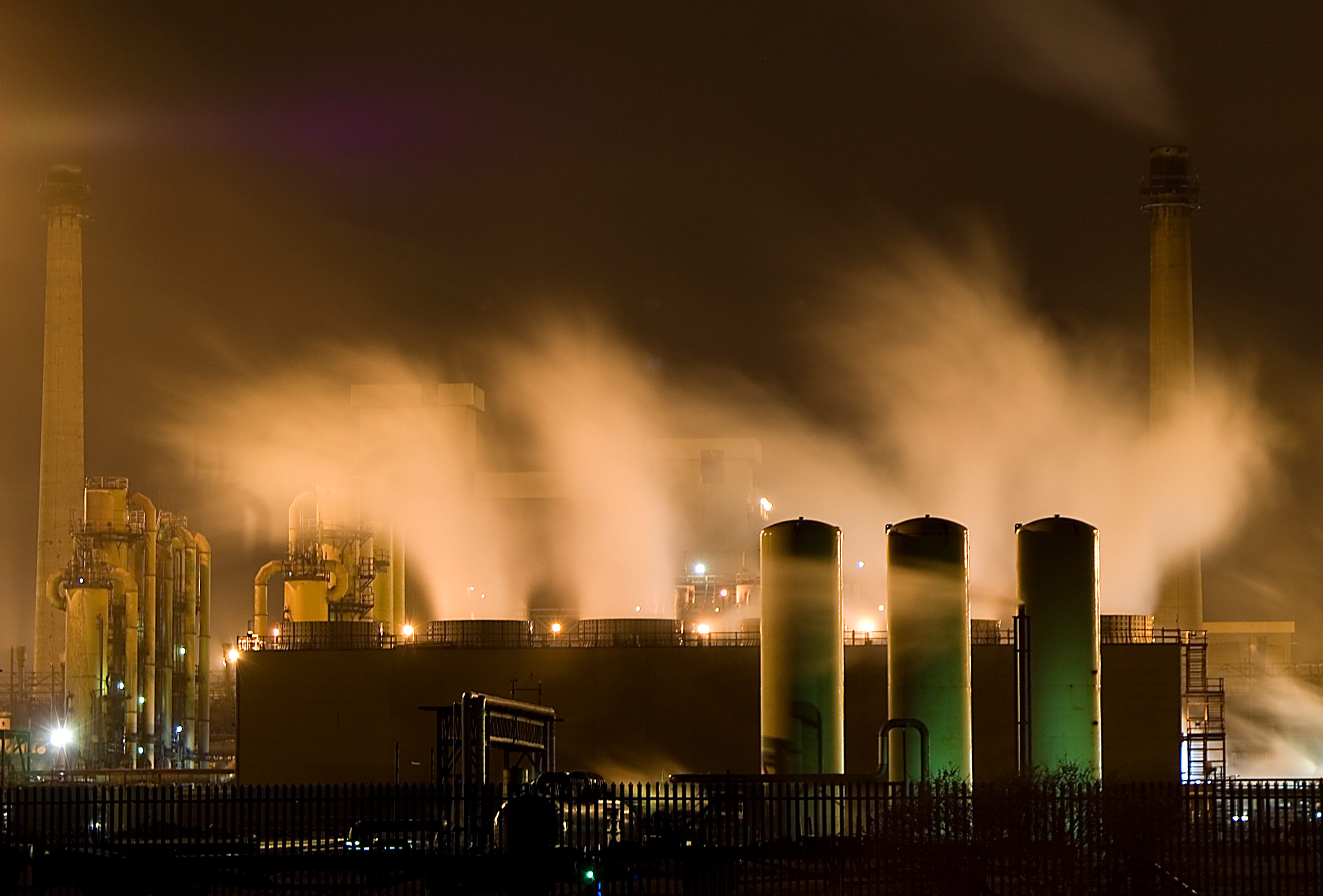
Redcar Steelworks at Night by Stuart Kerr - Corus Steel Works, RedcarUploaded by Computerjoe, CC BY 2.0, https://commons.wikimedia.org/w/index.php?curid=6737823
Early evening, A beach in north-east England. Looking landward one’s gaze is drawn towards a red glow. You can sense the force of it all, even from half a mile away. The heat. The energy. The raw power.
That was my experience over half a century ago, at the start of the 1970s, when I stood on the beach at Redcar, Teesside, in the north-east of England. The steelworks dominated the scene.
At that time I was working for Hertz Rent a Car where, for a while, I was District Manager for the Tyneside region in north-east England, working closely with my Teesside counterpart. It was an illuminating experience.
Business customers were (still are, I’m sure) crucially important for car rental firms and I learned a great deal about their needs and preferences. In the process, I got to meet a lot of them and visited the places where they worked. It’s how I learned about the Teesside steelworks. I learned, too, about the nearby ICI (Imperial Chemical Industries) plants at Wilton and Billingham which, at their peak in the 1960s and 1970s, employed around 40,000 people. And, being based in Newcastle on Tyne, I learned about the shipbuilding that had been in continuous existence there for centuries, and, of course, the local coal mining, together with other manufacturing sectors and all of the support functions that served everyone.
All of which is to say that my time in the north-east happened to coincide with a peak period of industrial activity. But twenty or so years later, things changed and virtually all of the industrial activity disappeared. What the hell happened?
Like anything else, the business world is subject to fashion. Which is to say, specific topics or practices come to the fore, dominate for a while, then drop back into the general background. And a practice that came out of nowhere to parade itself as ‘the shiny new thing’, in the 1990s and 2000s, was Outsourcing. There was an Outsourcing Boom.
Up until then, outsourcing had generally been applied only to peripheral services - cleaning, catering and the like. Indeed, the idea that one might outsource business-critical services was unthinkable.
It was, of course, the technology that did it - changed the ground rules, that is. Digital could provide and support all manner of services, and do so with such precision that, the advantages outgunned any conservative, inhibitory instincts.
Suddenly, it became possible to redistribute any and all functions of a business anywhere. As a consequence, the seductive question, “What if it can be done cheaper a few thousand miles away?” almost universally met with an enthusiastic, “Yes!”
It was all managed super-efficiently by management consultancies who, far from being dispassionate advisers, actually had strongly vested interests in the outcomes. The result? In the metaphorical twinkle of an eye, the effective deindustrialization of the West happened.
And the response to anyone who questioned it all …
“What about our long history of doing this kind of work here?” Silence.
“What about the livelihoods of the people who, for generations, have done this work here?” Tumbleweed.
A couple of key questions did however get answers that proved to be outright lies:
“What about the innovation potential in these sectors?” Answer: “Oh yes, that’ll stay here. We get to keep the high value knowledge work.”
“Might there not be some issues here regarding national security?” Answer: “No need to worry. This is a new, wonderful age for the world.” The idea that was put about was that, with the end of the Cold War (1989/1991), liberal democracy had become the dominant system for everyone: Francis Fukuyama’s “The end of history” and all that.
In the event, of course, it became clear that innovation tends to cuddle up close to where the manufacturing takes place and the post-1990 New World Order, despite being propped up with exaggerated claims of human-caused climate change and sustainability risks, was something of a chimera.
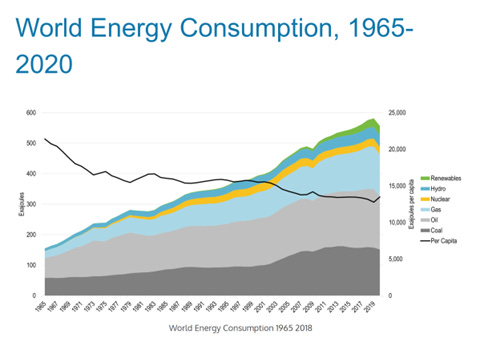
Image source: https://transportgeography.org/contents/chapter4/transportation-and-energy/world-energy-consumption/
So everything got outsourced. Energy included. Which means, not least, that many of the claims to great virtue by Western countries are outright lies. The energy use goes on and remains 80% to 85% fossil fuel based.
This is not to suggest that using renewables is anything other than a good thing, but let’s not fool ourselves that, yet-a-while anyway, they have become the major source of power. Specifically, let’s not fool ourselves by claiming that we have yet reduced fossil fuel usage at all.
Go to Teesside today and the air may smell sweeter than it did half a century ago but I think many would love to get a little of the old industrial energy back.
We are left, of course, with the legacy of the Outsourcing Boom.
It’s a topical issue here in the UK because, less than a week ago, in local elections, the governing Labour Party received a hammering. This, arguably, is one consequence of the Outsourcing Boom because the deindustrialization meant that, in very short order, a huge chunk of the Labour Party’s traditional membership of working persons - the very constituency that the party was originally created to serve - was unceremoniously dumped.
Subsequently, the Labour Party, in its run-up-to-the-millennium guise as ‘New Labour’, initiated the mass uncontrolled immigration that has surged, under both Labour and Conservative administrations, in recent years. (One factor in a set of outcomes that has led to these two political parties being labelled - not unfairly, I think - the Uniparty).
The idea seemed to be that the newcomers would act as a replacement for the old working class. But that never really made any sense to me. You outsource millions of jobs, rendering the incumbent workers redundant and throwing them onto the scrap heap, then ship loads more people in to … er … work. But at what?
That said, the incomers did supply a ready-made constituency who might be persuaded to replace the old working class in their capacity as voters, for a time anyway. And, indeed, some new work was created because it is surely no coincidence that, at the same time that ‘traditional work’ was dispatched from this cradle of the Industrial Revolution to anywhere else on Earth, the society left behind restyled itself into a fully-fledged ‘therapy culture’. As Frank Furedi points out:
What distinguishes circumstances today from past therapeutic regimes is that the system of therapy is not confined to a distinct and functionally specific role, it has merged with wider cultural institutions and has an impact on all institutions of society. 1
This has given rise to a hugely increased need for carers and therapeutic specialists of all kinds - particularly of the mental health variety. And it has all fitted hand in glove with a new bureaucratic management approach that has been a wholesale replacement for the political approach that had, not long before, made the West the factory of the world that had enabled and overseen the most astonishing improvements ever in human existence.
When it becomes possible for a majority of people to attain a living standard that until recently was available only to the very wealthiest is society, what do they do? Well, it appears that they complain bitterly that everything is unfair and inequitable, and that the conditions created by their good fortune cause unprecedentedly high anxiety levels.
Which is to say, when the positive energy was withdrawn from the industrial sector (which, insofar as human experience is concerned, surely represented an ordered, low probability state?) it’s as though it was transmuted into negative energy in the resulting society (the corresponding disordered, high-probability condition?).
I find the upshot of the post-Cold War ‘re-organizations’ fascinating. Here’s President Bill Clinton putting the case for China to be granted membership of the World Trade Organization (WTO). The speech was delivered at Johns Hopkins University on 8th March 2000:
By joining the WTO, China is not simply agreeing to import more of our products; it is agreeing to import one of democracy’s most cherished values: economic freedom. The more China liberalizes its economy, the more fully it will liberate the potential of its people – their initiative, their imagination, their remarkable spirit of enterprise. And when individuals have the power, not just to dream but to realize their dreams, they will demand a greater say.
China joined the WTO in December 2001 and the rest, as they say, is history. A history that hasn’t exactly worked out as President Clinton predicted. Thinking of just one Chinese company, a Google search today shows:
Foxconn employs roughly 1.2 to 1.4 million workers across its various sites in China, making it one of the largest private employers in the country. Its largest manufacturing campus, the “iPhone City” in Zhengzhou, employs roughly 200,000–350,000 workers, with staff counts increasing significantly during peak iPhone production season.
… but I don’t think China will be embracing liberal capitalism any time soon.
As we know, President Trump is trying to get American enterprises to pull their manufacturing out of China and, preferably, back into the U.S. - a sensible notion. But a difficult task:
The process of extricating manufacturing production from China will be prolonged and halting. International companies continue to tell me that they are still reluctant to completely pull up their roots from what remains an extraordinary production hub and a very big market. Apple is making immense efforts to cultivate production sites in Vietnam and India. But it is going to be gradual … 2
Meanwhile, it is surely questionable whether other parts of the West are doing enough to re-industrialize. In which context, note that Chinese president Xi Jinping is on record as saying:
The real economy is the basis of everything . . . we must never deindustrialize. 3
Would that the UK might re-learn this lesson!
The headline to this piece, as you probably already know, is from W,B.Yeats’ poem The Second Coming which includes.
Things fall apart; the centre cannot hold;
Mere anarchy is loosed up the world,
The blood-dimmed tide is loosed, and everywhere
The ceremony of innocence is drowned;
The best lack all conviction, while the worst
Are full of passionate intensity. 4
For a Western audience that looks rather too familiar, don’t you think?
Do subscribe, won’t you.
Frank Furedi. Therapy Culture: Cultivating Vulnerability in an Uncertain Age (2004)
Dan Wang. Breakneck: China’s Quest to Engineer the Future (2025)
Dan Wang. Ibid.
W.B. Yeats. The Second Coming (1920)